FAQ:
Updated: May 13
Why does my child need glasses?
The main reasons your child might be needing glasses are:
· Improve vision
· Straighten eyes that are misaligned
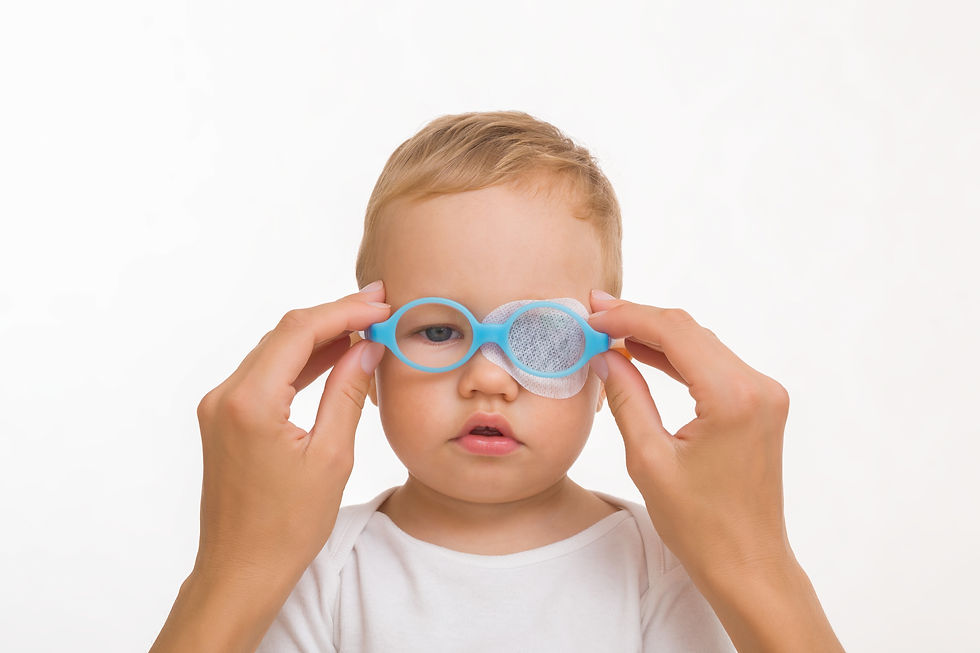
· Treat amblyopia
· Protect the better seeing eye in cases of 1 eye with very bad vision that cannot be improved.
Will wearing glasses full time make my child’s eyes weaker and more dependent on them?
No. Wearing glasses, that are prescribed by a paediatric eye specialist, will not worsen, but improve your child’s vision and insure normal visual development.
The strength of the glasses should not be confused with the level of vision achieved.
Will my child accept the glasses?
The majority of young children will adapt to their glasses quite quickly as they can see better through them.
If this is not the case and your child is reluctant to wear their newly prescribed glasses, try to gradually increase the time that your child wears them and continue to encourage your child while maintaining a positive attitude.
4. What do the positive and negative signs mean in my child’s prescription?
There are 4 types of refractive error in children:
· Myopia( Shortsightedness): The vision is blurred for distance targets but usually clear for near targets. The prescription for glasses will have a minus sign (-) at the beginning (ex. -1.00 sph).
· Hypermetropia(Longsightedness): It is normal for children to have a degree of hypermetropia in early life and usually do not need glasses treatment, unless the degree of hypermetropia is higher than what is expected for each age group and this is affecting the vision and/or ocular alignment. If this is the case, a hypermetropic prescription is issued. In this case there is a plus sign (+) at the beginning of the prescription (ex. +2.00sph).
· Astigmatism: Children with an astigmatic refractive error can have blurred or distorted vision at any distance. In a glasses prescription the astigmatism is the second number followed by the axis ( -2.00sph/-1.00 cylx180).
· Anisometropia: Occurs when there is a difference in the refractive error between the eyes. Anisometropia can lead to amblyopia, where the vision in one or both eyes does not develop properly and early glasses intervention is vital for normal visual development.
Do I get a voucher for my child’s prescription?
If you are having a private eye consultation for your child, you are not eligible for an NHS voucher and you will need to pay for your child’s glasses prescription.
Comments